CULTURAL PROPERTY PROTECTION • OSONWANNE GROUP LLC
Cultural Property Identification Tool: screening leads, with the reasoning attached
A proof-of-concept AI screening tool that helps U.S. law enforcement flag objects that may fall under U.S. cultural property import restrictions. An analyst submits a photo. An AI model running entirely on the analyst’s own device compares it with vetted, open-licensed museum images and returns ranked candidate categories, the closest reference objects and a written rationale. A person records the decision.
The prototype at a glance
Built in response to U.S. Department of State RFQ 19AQMM26Q0468. Figures are from a held-out test set of 139 images the model never saw.
6
Countries restricted under 19 CFR §12.104g: Ukraine, Egypt, Peru, Greece, China and Cambodia
550
Vetted, open-licensed museum images across 13 designated-list categories (75% CC0 or public domain)
0
Outside connections while screening. Images never leave the analyst’s device
95%
Held-out images with the correct category in the top three (86% top-1)
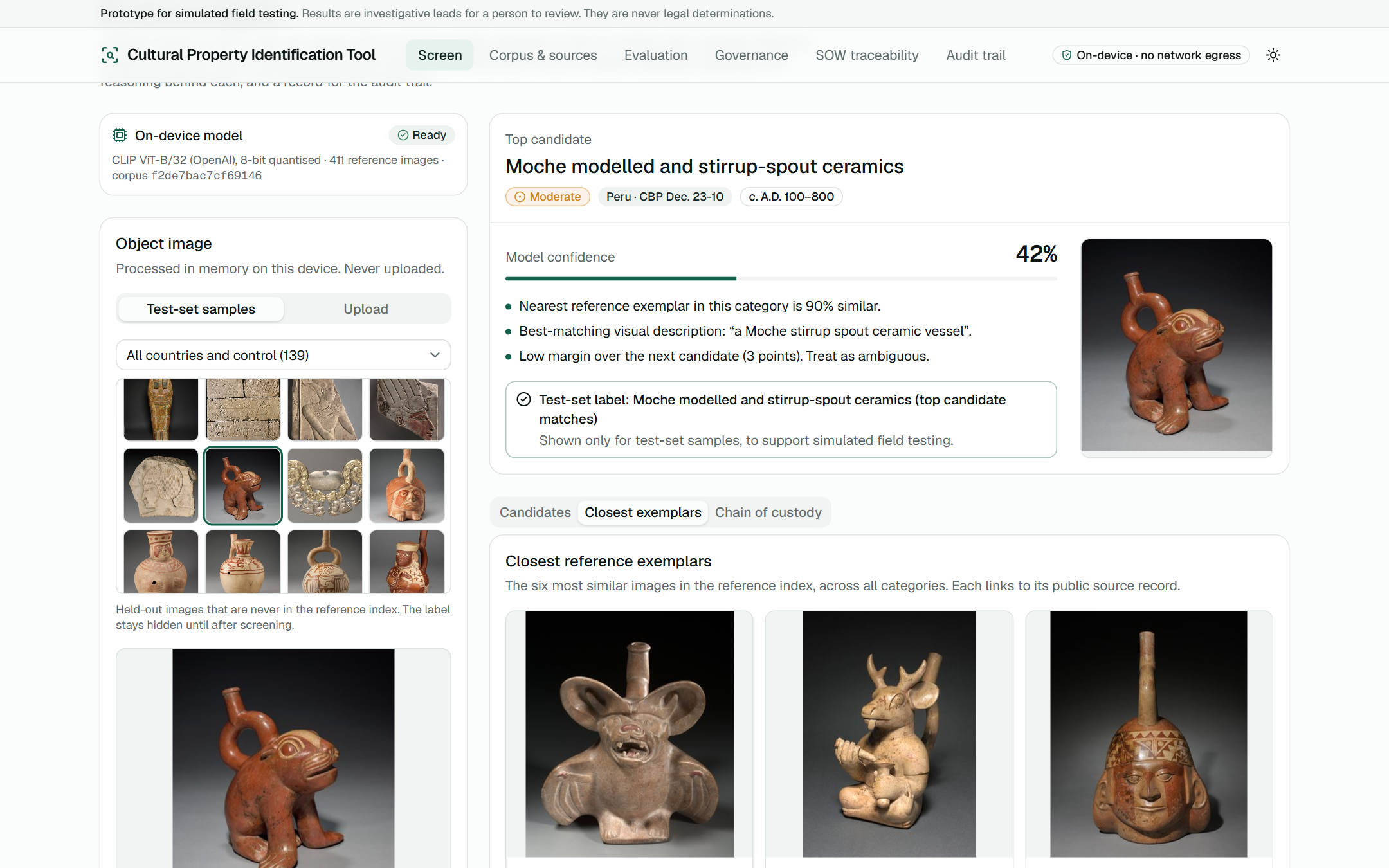
How a screening works
STEP 1
Submit an object image
The analyst uploads a photo or picks a held-out test sample. The image is processed in memory on the analyst’s own device and is never uploaded.
STEP 2
Ranked candidate matches
The tool ranks designated-list categories, from Scythian goldwork to Moche ceramics to Shang bronzes, and shows the most similar reference objects with links to their museum records.
STEP 3
A person decides
The analyst records the disposition. Every screening is written to a tamper-evident, hash-chained audit trail before the result appears, and the log exports to CSV.
Built for the field, not the network
The statement of work calls for a standalone tool with no connection to State Department or other government systems. The prototype was designed around that requirement from the start.
AIR-GAP READY
Runs disconnected
The model, runtime and reference index are self-hosted and run in the browser. A strict security policy blocks every outside connection, and the app keeps working offline.
PUBLIC DATA
Open-licensed, fully traceable
Images come from the Cleveland Museum of Art, the Art Institute of Chicago, The Met, Europeana and Wikimedia Commons. Every image keeps its source, licence and fingerprint, and every vetting rejection is logged.
GOVERNED
Model card and NIST AI RMF
Built-in pages cover the model card, a NIST AI Risk Management Framework mapping, the security scan results, a path to FedRAMP, and a line-by-line trace to the statement of work.
Honest about what it is
Studio photos, not field photos
Test images come from the same museum sources as the references. Field imagery will score lower, which is why simulated field testing with subject-matter experts is part of the plan.
Data gaps are published
Some categories, including Ukrainian icons and Trypillia ceramics, rely on stylistically close stand-ins. The app lists every gap alongside the category it affects.
A low score means nothing
The corpus covers a fraction of protected material, so the tool is not calibrated to clear an object.
See it running
The Cultural Property Identification Tool was submitted to the U.S. Department of State in response to RFQ 19AQMM26Q0468. Explore the evaluation copy or book a walkthrough.
Questions? Contact us • Bon@Osonwanne.com • 602-632-9589
The Cultural Property Identification Tool is a prototype by Osonwanne Group LLC for evaluation purposes. It produces investigative leads, not legal determinations, and nothing it outputs establishes the provenance, ownership or admissibility of any object. Category descriptions paraphrase published designated lists; the authoritative text is the designated list as published by U.S. Customs and Border Protection. Submission of a quote does not imply selection or endorsement by the U.S. Department of State.